
1Live bed bug
Flattened, wingless, reddish-brown insect. After feeding the abdomen becomes fuller and darker.
Tip: check the joints of the bed frame and the seams of the mattress.

Bed bug specialists · Budapest and Pest County
Discreet, targeted and documented bed bug treatment. Two clear treatment options, a 30-second guidance tool and a postcode-based price calculator.

Is it really bed bugs?
Bites alone do not prove that bed bugs are present. The insect, the dark faecal spots, the eggs and the shed skins together give a far more reliable picture.
Flattened, wingless, reddish-brown insect. After feeding the abdomen becomes fuller and darker.
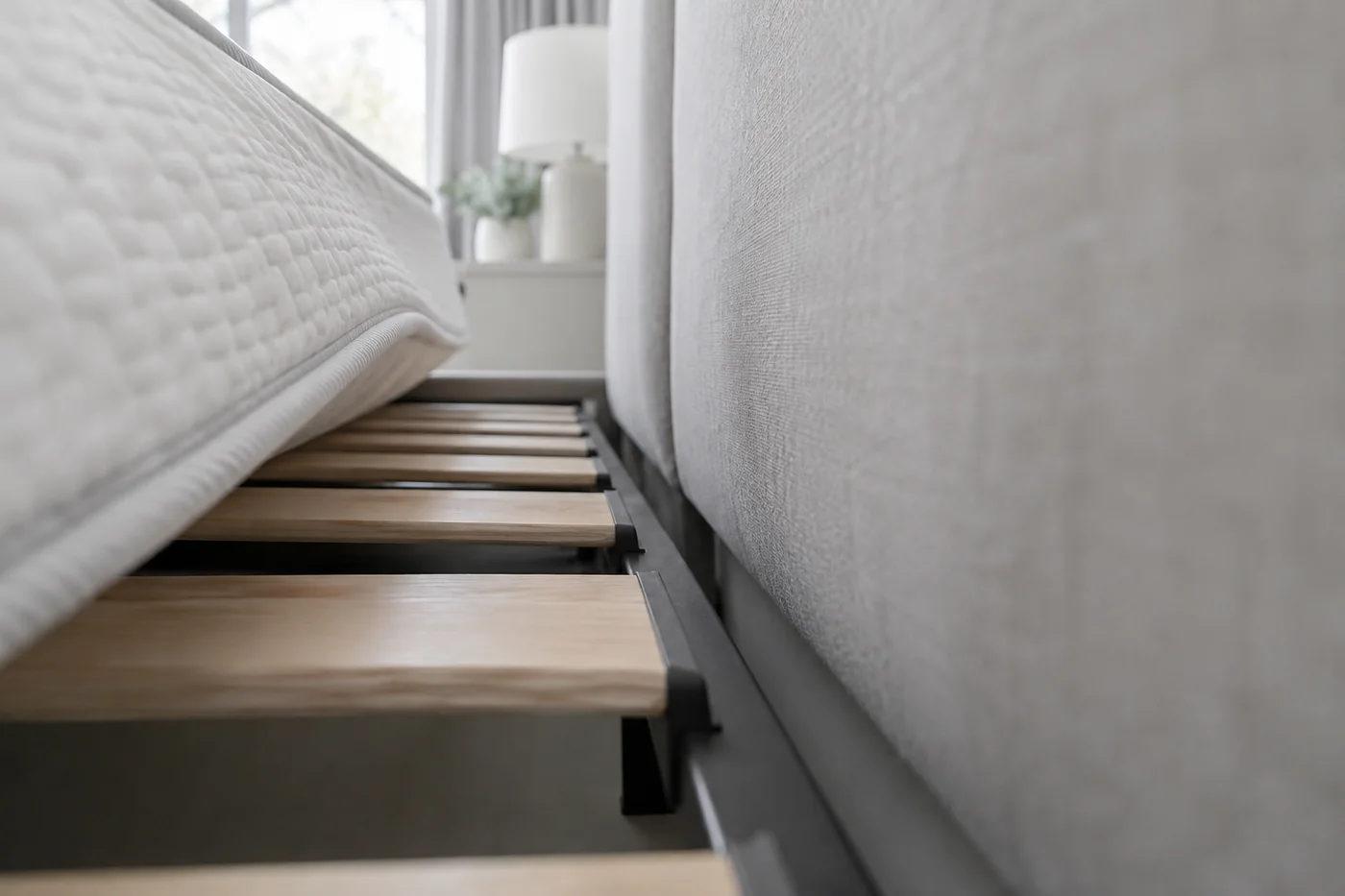
Tip: check the joints of the bed frame and the seams of the mattress.
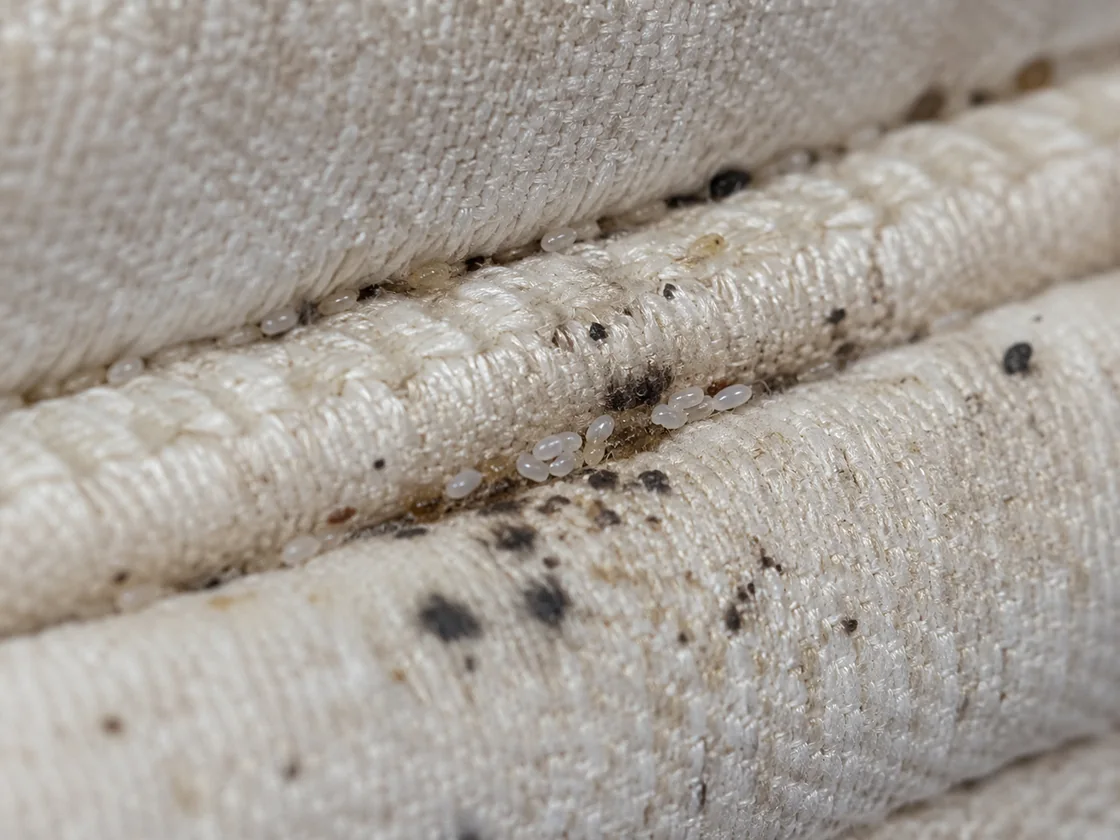
Tiny, dark faecal marks, usually around harbourages, along mattress seams and on the bed frame.
Many dark specks concentrated in one place are a strong warning sign.
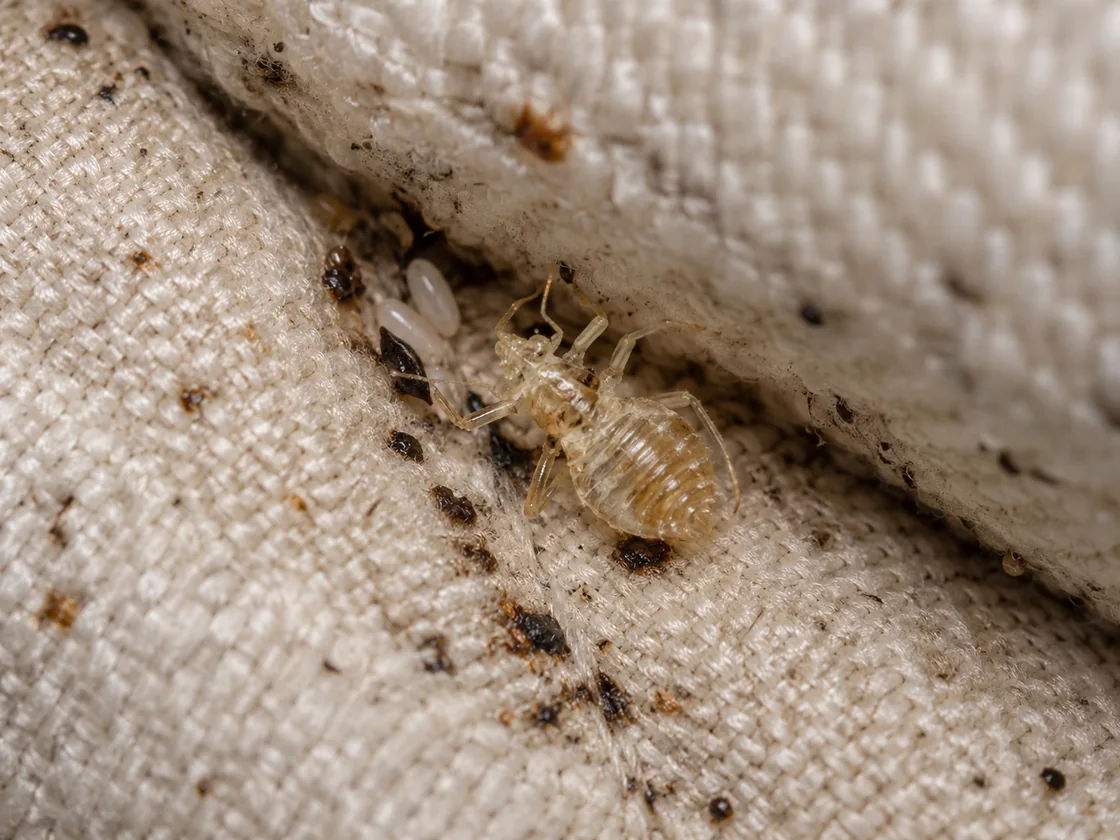
Pale, tiny eggs and translucent yellowish moulted skins near hiding places.
These are easily mistaken for dust or textile fibres.
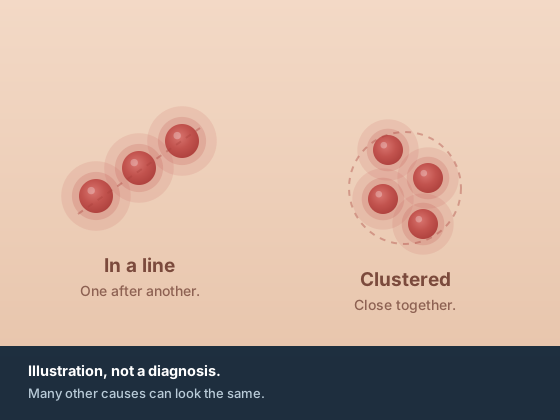
Often appear in clusters or in a line, but many other causes can produce similar skin reactions.
Do not start treatment on the basis of bites alone – identify the pest first.
The preview is generated locally, in your own browser.
Two treatments, no package maze
There is no single right method for every bed bug situation. We choose the technology based on the extent of the infestation, the history, the number of sleeping places and how accessible the harbourages are. The aim is not to spray the whole room, but to treat the identified hiding points precisely.
A good choice for a recently noticed, well-defined infestation, where the on-site survey shows that targeted insecticide treatment alone is justified.
from 32,900 HUF
For simpler cases, targeted.
Recommended for long-standing infestations, cases involving several sleeping places or rooms, or where an earlier treatment failed. We combine mechanical reduction and heat treatment of accessible insects with targeted insecticide work.
from 58,900 HUF
We do not simply spray everything: each method is used where it makes professional sense.
Which one do I need?
This tool is not a diagnosis. If you only see bites but no physical traces, start with identification.
Based on your answers
Standard treatment
Your answers suggest a recent or smaller infestation. The on-site survey may of course change this.
Price calculator
Enter the postcode, the treatment type and the number of affected rooms and sleeping places. The calculator shows only the expected total, call-out included.
Based on the postcode, the calculator shows the expected total treatment fee including the call-out.
How it works
Professional bed bug treatment begins with a survey and ends with follow-up. We tell you what to expect at first contact, and on site we adapt the work to the actual infestation and the harbourages we find.

Checking the bed, mattress, furniture and critical harbourages.
We move and dismantle only what is professionally necessary.
Using the technology that fits the chosen option and the situation on site.
We explain exactly what to do and what to avoid after treatment.
More than spraying a room
The combined treatment is built on an integrated approach: detection, physical population reduction, heat and targeted insecticide treatment, each building on the last.
We build the treatment around the bed, mattress, furniture joints, skirting boards and other harbourages.

We find the actual harbourages and establish how far the infestation reaches.

Vacuuming immediately reduces the number of accessible insects and their remains.

Direct heat on suitable, heat-resistant surfaces – especially around the sleeping area.

Approved insecticide at hidden points, applied according to the label.
Why a repeat may be needed
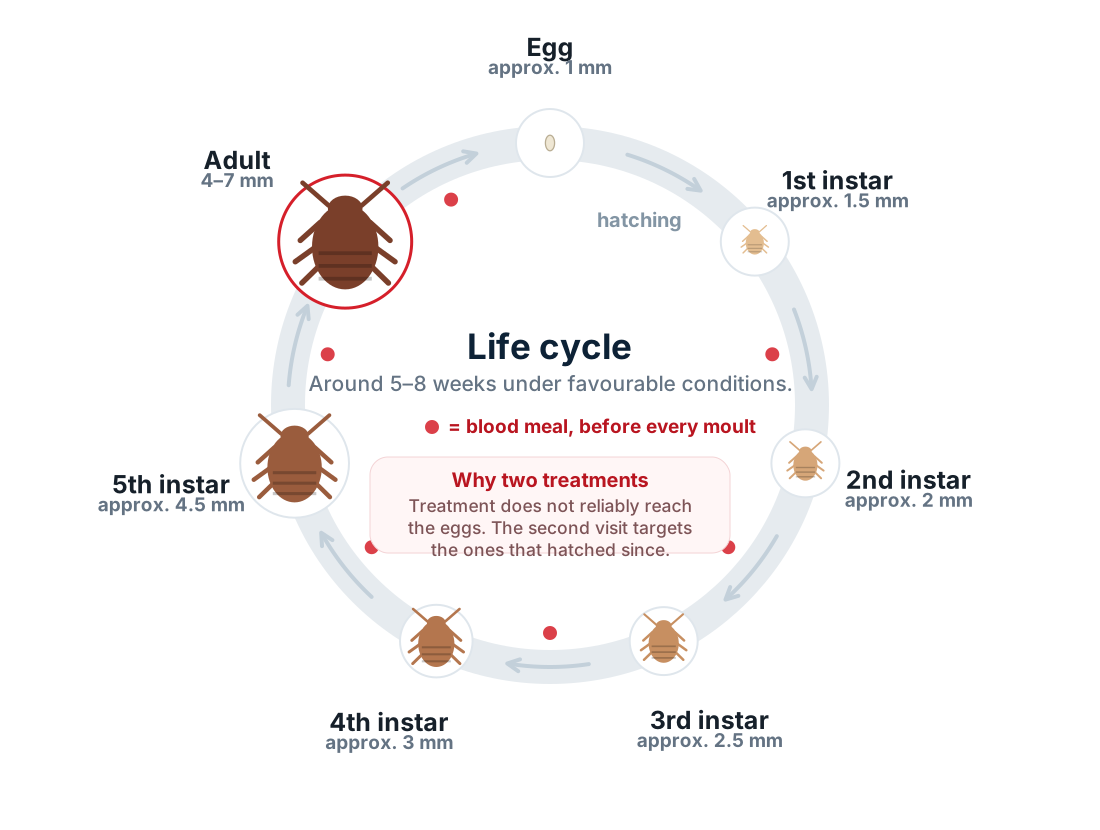
Bed bugs hatch from eggs and pass through five nymph stages. Each nymph needs a blood meal before every moult. Because of the eggs and the hard-to-reach harbourages, the result should not be judged in the first few days, but through a check and, if needed, follow-up treatment.
This is why we do not irresponsibly promise a one-visit, permanent fix. If a repeat is justified, the second treatment of the same area is charged at a reduced 70% rate.

Did you know?
Short and plain – without the usual misunderstandings.
The flattened body of an adult bed bug lets it hide in very narrow cracks and joints.
A wingless insect that moves by crawling. Long distances are usually covered with us – in luggage or on objects.
A nymph passes through five stages before reaching adulthood, and needs a blood meal before every moult.
In cooler conditions it can stay alive for a particularly long time, so leaving a room empty does not necessarily solve the problem.
Exhaled carbon dioxide, body heat and odours together guide it.
It can appear in a clean, tidy home and in a high-quality hotel alike. It arrives by being carried in.

Especially important in blocks of flats
In a block of flats bed bugs spread not only by being carried in, but also between flats – along structural gaps and pipe or cable penetrations, for example. In recurring cases or where several flats are affected, targeted inspection of neighbouring flats and coordinated treatment reduce the chance that the source stays hidden.
Preparation and aftercare
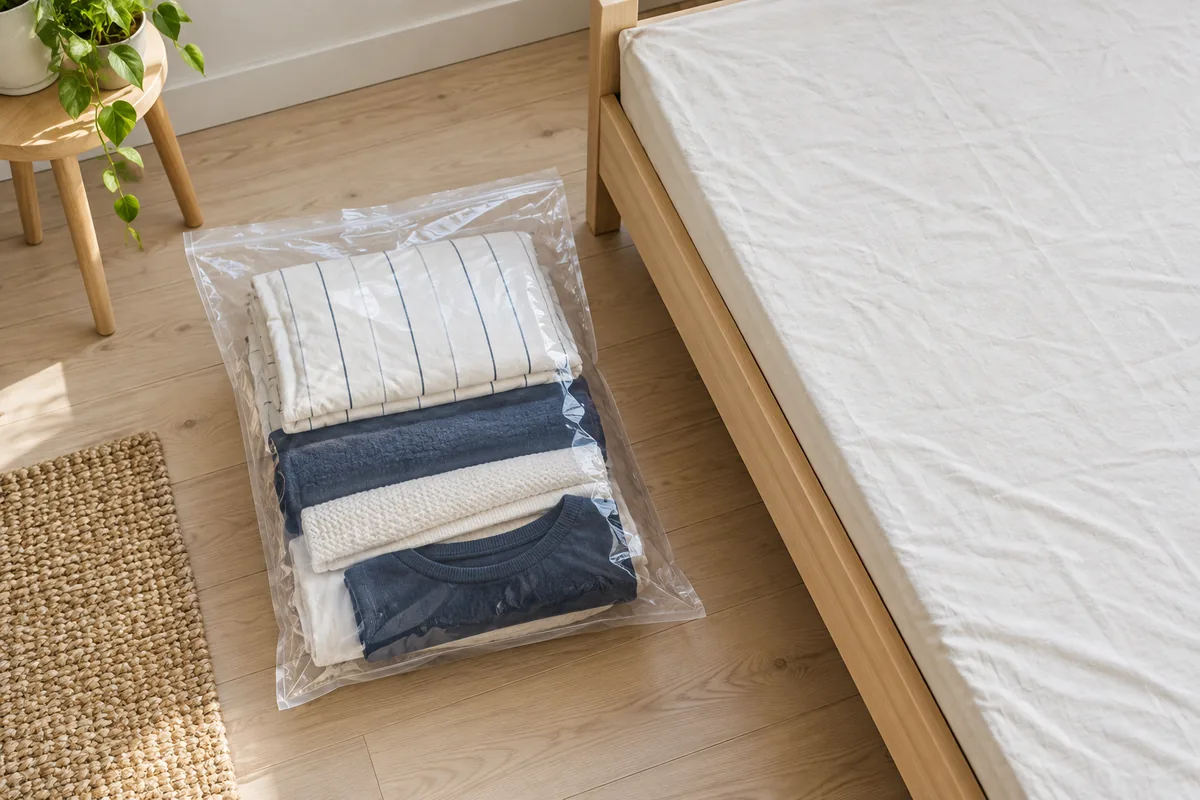
Excessive packing can spread the bugs around and make detection harder. Prepare only what we actually ask for the agreed technology; the exact list always depends on the site and the treatment.


Travel and hotels
Mattress seams, headboard, bed frame – look for dark spots and shed skins in particular.
Use a luggage rack or a hard, easily inspected surface.
Do not unpack in the bedroom. Treat washable clothing according to its care label; where permitted, high-temperature tumble drying is particularly effective against bed bugs and their developmental stages.
Identify the problem first, and only then decide on the next steps.
Found a bed bug?

Do not move bedding or objects into another room.
Random insecticide sprays can scatter the problem.
Discarding the bed or mattress is often unnecessary.
Sleeping in another room can push the bugs towards new harbourages.
Bed bugs in brief
Bed bugs do not live on people: after feeding they usually withdraw to a nearby harbourage. The key to successful control is therefore not treating the bites, but proving an active infestation, finding the hiding points and combining the methods that fit the situation. A bite is not a diagnosis, and cleanliness alone is no protection against being carried in.

Discretion
We work discreetly, professionally and without unnecessary attention. In our communication too, we ask only for the information the treatment actually requires.
Discreet
work
Transparent work
With bed bugs, realistic expectations and clear aftercare rules matter as much as the intervention itself.
On site we tell you what we found, which areas we are treating, what technology we use, when you can return and what to watch for in the following days.
The success of a treatment cannot responsibly be summed up as a one-line „100% guarantee”. We talk everything through on site, and at the end of the job the work sheet records what we agreed – what we treated, with what, and what to do next.
Service area
We work out of Veresegyház. Based on the postcode, the calculator automatically shows the expected total treatment fee, call-out included.
Every district of Budapest, and among others:
Places not on the list are not excluded – enter the postcode in the calculator, or message us.

CIMEX Knowledge base
Open the topic that interests you. The summaries are here on this page; we do not send you off to another article. The content is based on Hungarian and international public health, university and pest control guidance.
The bed bug (Cimex lectularius) is usually 4–7 mm long as an adult: flattened, oval, reddish-brown and wingless. It neither jumps nor flies: it moves by crawling. Before feeding its body is distinctly flat; afterwards it becomes fuller, more elongated and darker. The young stages, the nymphs, are smaller and paler, which makes them particularly easy to overlook.

Always begin the inspection immediately around the sleeping area. Typical harbourages are mattress seams and piping, bed frame joints, the slats, the back of the headboard, the bedside table, skirting boards, wall cracks and other narrow gaps. In a more extensive infestation the insects may also appear further from the bed, for example in upholstered furniture or other hidden points.
Bites alone are not enough for identification. Mosquitoes, fleas, other insects, skin irritation or an allergic reaction can all cause similar symptoms. For a firmer conclusion, always look for physical signs in the surroundings alongside the skin reaction. A heavy infestation may also produce a sweetish, musty smell, but this too should not be treated as a diagnostic sign on its own.
Rule of thumb: if you only see bites, identify first. If you also find an insect, a shed skin or characteristic faecal marks, the suspicion is far stronger.
Bed bugs usually feed at night. Many people do not feel the bite itself, because substances entering the skin during feeding reduce immediate sensation and help the blood flow. The skin reaction therefore does not necessarily appear straight away: within hours for some, only days later for others.
There is no single typical bed bug bite that allows a certain diagnosis. The reaction may be a small, itchy red papule; several bites may appear close together or in a line, but this is not exclusive to bed bugs. Some people develop barely visible marks, while others react more strongly. A more significant allergic reaction is rare but possible.
According to current public health knowledge bed bugs are not a known transmitter of infectious disease between people. Even so, an infestation can seriously affect quality of life: alongside the itching, sleep disturbance, anxiety and sustained stress can all develop.
From a pest control point of view the aim is not to treat the skin marks, but to prove that bed bugs really are present, and then to eliminate the harbourages and the active infestation.
Bed bugs develop by incomplete metamorphosis: there is no caterpillar or larval stage. The order of the life cycle is: egg → five successive nymph stages → adult. A nymph already resembles the adult, only smaller, paler and sexually immature.
At room temperature and under favourable conditions, eggs may hatch in roughly 5 to 10 days. A nymph must take a blood meal before every moult in order to reach the next stage. Temperature, access to food and other environmental factors strongly influence how fast development proceeds.
Eggs can sit in hidden crevices, joints and other protected points. An intervention that reaches most of the mobile stages present does not necessarily reach every egg or every deeply hidden individual. Follow-up is therefore not an optional safety round, but a checkpoint that follows from the biology.
An important professional clarification: with bed bugs we speak of nymphs, not larvae. Understanding the five nymph stages helps explain why control has to be treated as a process, not as a one-off spray.
Modern bed bug control is based on integrated pest management (IPM): it does not expect the whole result from a single tool or active ingredient, but combines the methods that suit the site. The first step is always the survey. It must establish whether bed bugs really are the cause, how large the infestation is, how many rooms and sleeping places are affected, and where the likely harbourages are.
Mechanical removal – targeted vacuuming with suitable filtration, for example – can immediately reduce the number of accessible individuals. Steam and other heat methods can damage or kill the bugs and eggs they reach directly, but only work where the required heat actually arrives. Too strong an airflow, on the other hand, can scatter the insects, so the technology and the way it is applied are critical.
The role of insecticide treatment is the targeted treatment of hidden harbourages, cracks and crevices. The aim is not to spray the whole room indiscriminately, but to apply the approved product as prescribed, at the biologically justified points. The product label and its approved use always take precedence.
The CIMEX combined treatment follows the same logic: where possible we reduce the pressure physically and with heat; where necessary, targeted insecticide treatment completes the work.
Good preparation helps the treatment, but excessive or badly done packing can spread the bugs around. The most important principle is not to move an infested or suspect item into another room unchecked. Anything that has to be moved should first go into a sealed bag or a container that closes well.
Bedding and treatable textiles should be handled according to the preparation guide. High-temperature tumble drying can be a particularly effective tool; the US EPA specifically notes that washing alone is not always sufficient. The Hungarian NNGYK recommends washing at at least 60 °C and, where available, high-temperature drying for suitable textiles. The care label of the textile must always be taken into account as well.
A mattress encasement, monitoring traps under the bed legs and reducing the number of harbourages can also make follow-up easier in some situations.
The aim is not to empty the whole flat. The aim is that the points to be treated are accessible, while nothing is carried into a clean area uncontrolled.
In a multi-unit building, bed bug control does not always stop at the door of the affected flat. The insects can pass into other flats through gaps, wall penetrations and around cable and pipe routes , but it is also common for them to travel from one place to another on objects or personal belongings.
It does not follow that a single sighting means the whole building must automatically be treated. The professionally correct step is first to establish how far the infestation reaches. Several US university guides recommend that, where an infestation is confirmed, the directly neighbouring flats – particularly the units above, below and beside it, and in some buildings across the corridor – should also be checked.
In such situations, involving the building manager or the property manager can help with coordinated detection. Alongside the treatment, sealing technical penetrations, gaps and cracks, and monitoring, can also be important.
The aim is not automatic mass treatment, but finding the source. If an untreated neighbouring source remains beside the infested flat, the risk of reappearance is higher.
Bed bugs are classic stowaways: they travel easily from one place to another in luggage, on clothing or on other objects. The cleanliness or star rating of a hotel does not rule them out. The insect is not looking for dirt; it hides close to a blood source.
There is no need to take the room apart. A quick, targeted check is there so that the obvious signs of a heavier infestation – live insects, shed skins, black faecal marks, blood stains – are noticed in time.
Try not to unpack in the bedroom. Handle washable clothes separately and, where the textile allows, use high-temperature drying. Inspect the suitcase thoroughly, especially at seams, zips and pockets. For longer-term storage it is sensible not to keep the suitcase directly under the bed.
Prevention is about controlling the luggage, not about panic. A few minutes of checking and a deliberate routine on returning home significantly reduce the chance of bringing them in.
If bed bugs reappear after a treatment, it is easy to assume straight away that the product did not work. In professional practice, however, a treatment can fail for several entirely different reasons.
Insecticide resistance is a real phenomenon, but it cannot be established with certainty by visual inspection on site; without laboratory testing it is not fair to blame every treatment failure on it. This is why combining methods, deliberately using different modes of action and including non-chemical elements all matter.
The US EPA specifically points out that bed bugs can fit into crevices barely wider than the thickness of a credit card. The quality of detection is therefore at least as important as the product itself.
A good follow-up inspection does not ask whether the chemical worked, but where activity may have remained, why, and at which point the treatment plan needs to change.
There are home measures that can genuinely help reduce an infestation or slow its spread: targeted vacuuming, high-temperature washing and drying of treatable textiles, tidying the area around the bed, handling items in sealed containers, mattress encasements and monitoring traps. These are only useful, however, if they do not spread the bugs around.
Steam can also be an effective tool against the stages it reaches directly, but it requires the right temperature and slow, controlled application. The EPA warns that too strong an airflow can scatter the bugs. Heating a room at home with a heater, oven or other improvised device, on the other hand, is a fire hazard and does not provide a controlled, even lethal temperature.
If the infestation affects several rooms, has persisted for a long time, returned after an earlier treatment, or the source cannot be found reliably, involving a specialist is usually the faster and more predictable route.
The best role for home measures: safe population reduction, containment and monitoring – not uncontrolled chemical use.
Professional background: NNGYK, CDC, US EPA, Bed Bug Foundation European Code of Practice, BPCA, Penn State Extension, Rutgers Cooperative Extension and University of Minnesota Extension.
FAQ
Bites alone are not proof. Firmer signs are a live or dead bug, a shed skin, tiny black faecal marks, a rusty blood-like stain or an egg. If you are unsure, photograph the insect or the trace and send it for identification.
There is no fixed number for every infestation. An early, well-defined case and a long-standing infestation across several rooms may need different treatment plans. Because of hidden eggs, harbourages and a possible neighbouring source, a check or a repeat treatment may be necessary; we decide this from the follow-up results.
That depends on the technology and the product used. For insecticide treatment, the conditions for returning are always set by the approved use of the product and the conditions on site. We state the exact absence, drying and ventilation times clearly before the treatment.
Not automatically. Many mattresses and bed frames can be kept with proper inspection and treatment. Unnecessary disposal can also spread the bugs into the stairwell or other parts of the flat. We only recommend discarding something when there is a genuine professional reason.
Do not carry bedding, clothes or objects into another room, and do not start using an assortment of shop-bought insecticides. Make the area around the bed accessible, handle textiles to be moved in sealed bags, and follow the preparation guide sent for the specific technology.
The return time cannot be given as a single general number of hours. We give precise, site-specific instructions based on the product label, the drying of treated surfaces, ventilation and the technology chosen.
According to current knowledge, bed bugs are not a known transmitter of infectious disease. The bites can, however, cause itching, sleep disturbance, rarely a strong allergic reaction, and secondary skin infection from scratching.
Yes. Bed bugs are not looking for dirt; they feed on blood and most often arrive in luggage, on clothing, with second-hand furniture or on other objects. In a block of flats they can also come from a neighbouring flat.
No. We do not offer a results guarantee for bed bug control, and we say so deliberately: bed bugs can be brought back in at any time – while travelling, with second-hand furniture, or from a neighbouring flat in a block. That does not depend on the quality of the treatment, so a lifetime guarantee would only last until someone tried to use it.
What we do commit to: carrying out the two-visit treatment programme properly. The second treatment of the same area costs 70% of the first. We talk the process, the follow-up and your tasks through on site, and the work sheet issued at the end records what we agreed.
CIMEX
Find out in 30 seconds what the treatment costs.
Get in touch
A few details are enough. We handle English enquiries in writing and usually reply within a few hours on working days.